

A small dose, every day.
Home lines up four ten-minute activities picked for your rotation. Each one you finish drops a capsule into your weekly pill organizer, so you can see at a glance whether you kept the rhythm.
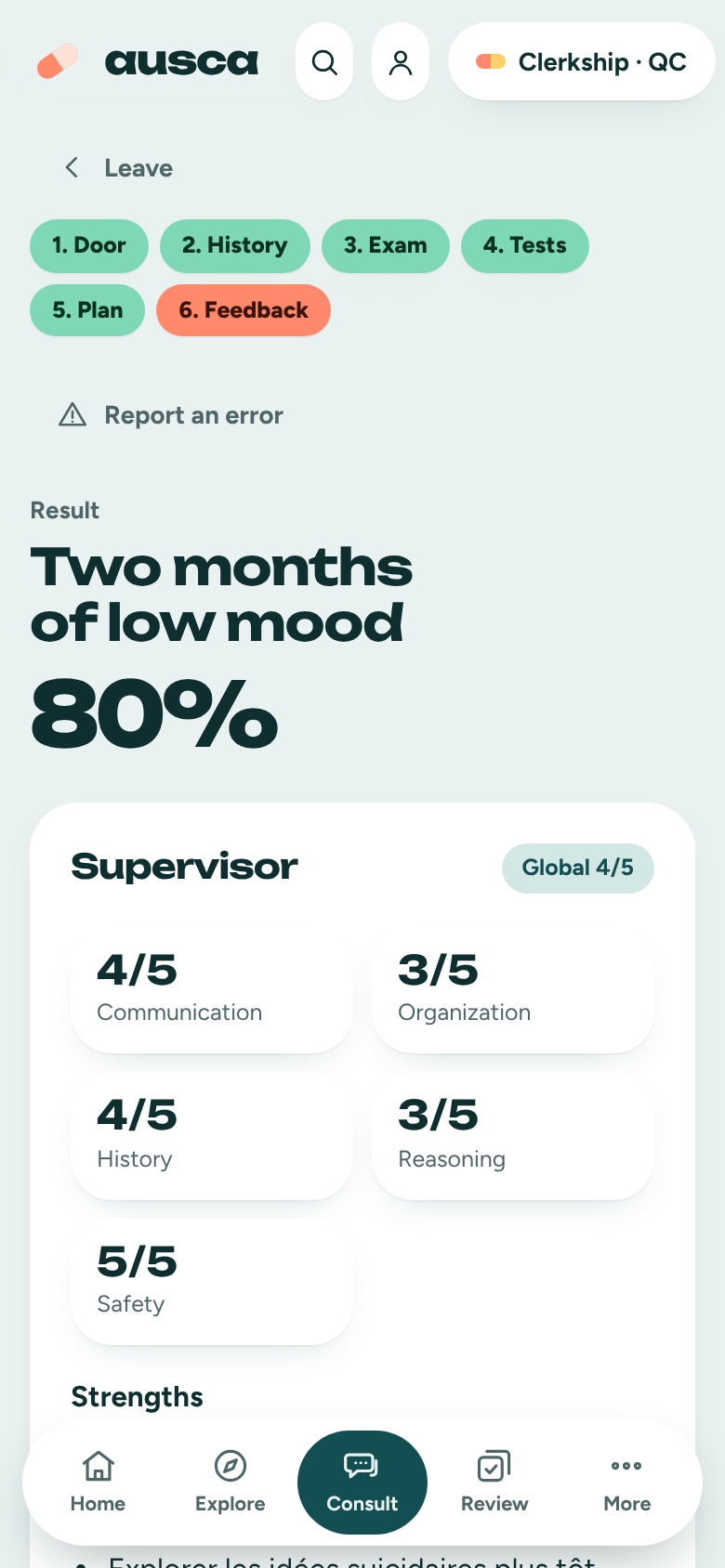
Patients who react to how you speak.
Ask out loud or type. An open, empathic question gets a real answer; a closed or rushed one gets a short reply. Then you examine, order tests, commit to a diagnosis and a plan.
Feedback scores communication, organisation, history, reasoning and safety, with the questions you could have asked.
A library that tells you where it comes from.
Clinical sheets, flashcards and cases across medicine, in English and French. Every item carries a badge that says who made it and how it was checked.
Spot an error? Every sheet, card and case has a “Report an error” button. Reports are reviewed and fixed every week.
Adapted to where you train.
Québec
- SI units, Québec law (confinement, capacity, youth protection)
- INESSS, INSPQ, RAMQ
- MCCQE
Canada
- SI units, provincial mental health acts
- Canadian guidelines (CCS, SOGC, CPS, Diabetes Canada)
- MCCQE
United States
- Conventional units (mg/dL, °F)
- ACC/AHA, ACOG, AAP, USPSTF
- USMLE Step 1, 2 CK and 3
Free to learn. Paid only for AI.
What costs us almost nothing stays free. The subscription pays for AI patients, which cost money every conversation.
- Every clinical sheet, flashcard and case
- Spaced repetition and the pill organizer
- Inspection of animated patients
- Interviews with scripted patients
- Duels and cohort leaderboard
- 15 interviews a month with an AI patient who truly understands your questions
- Detailed OSCE-style feedback after each interview
- Flashcards made from your notes
- New patients on the presentation you choose
30-day free trial when you create an account. Cancel anytime. Taxes extra.
Try 30 daysQuestions
Can I use it to care for a patient?
No. Ausca is a training tool. It doesn’t diagnose, doesn’t recommend treatment for real patients and doesn’t replace supervision or official guidelines.
Can I paste my rotation notes?
Yes, as long as they contain no real patient information. Ausca blocks text that looks like a health card or chart number, but removing it is up to you.
Who writes the content?
AI agents write each sheet from cited public sources, then a second, independent agent checks every number against the source. Residents and physicians then review sheets: their name appears on the sheet, with the green badge.
Where does my data go?
Your account and progress are hosted in Canada. Conversations with the AI patient are processed by an AI provider in the United States, without your name or email. No ads, no trackers. You can download or delete your data anytime in the app. Privacy policy
Does it work on iPhone?
Yes, in Safari, and you can add it to your home screen. The iOS app, with a continuous microphone, is coming soon.